Seminar | Learning Transition Pathways Using Artificial Neural Networks
2025-09-12
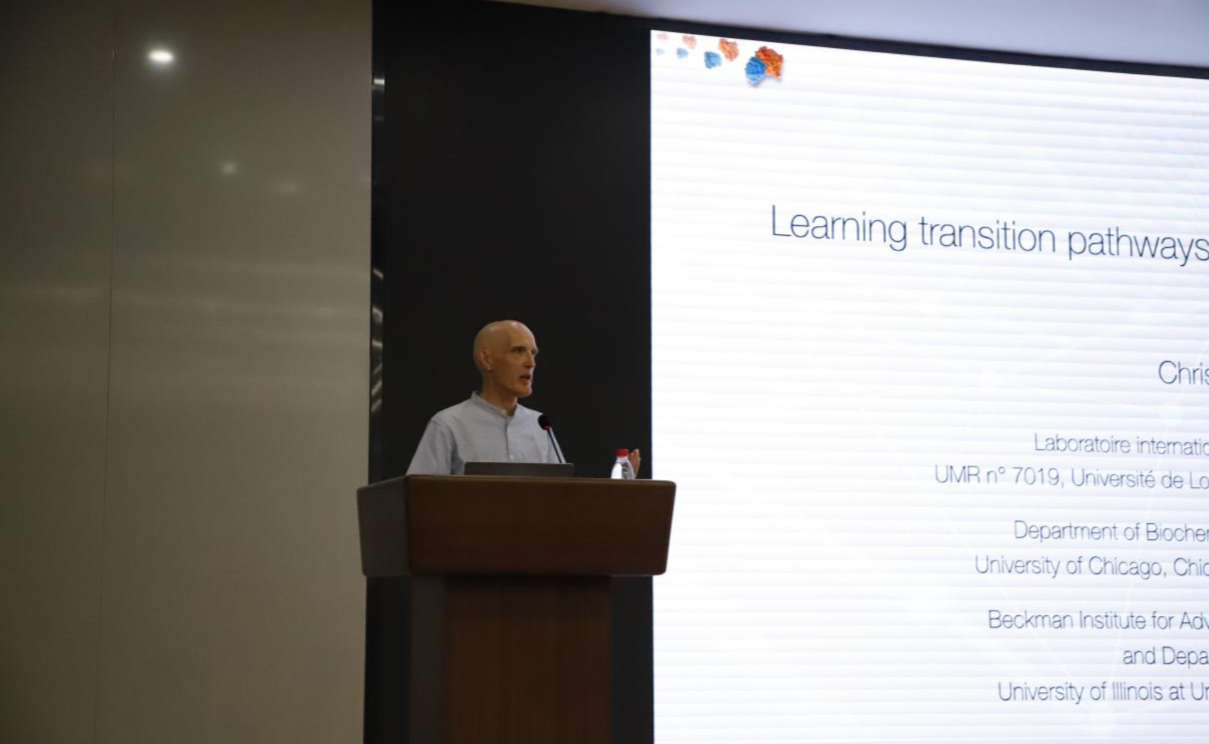
Chris Chipot
On September 10, 2025, Professor Chris Chipot from the French National Centre for Scientific Research (CNRS) presented “Learning Transition Pathways Using Artificial Neural Networks.” The seminar introduced a novel framework leveraging artificial neural networks to elucidate the dynamics of rare events in molecular systems.
Professor Chipot reported a new strategy centered on the simultaneous learning of the committer function and committer-consistent strings. Based on committer time-correlation functions, this approach provides a robust methodology for identifying transition mechanisms across diverse dynamical regimes and distinguishing between competing pathways, addressing long-standing limitations in traditional sampling methods.
The presentation highlighted the method’s capacity to accurately capture kinetic processes, rate constants, and transition mechanisms, as validated across various benchmark potential energy surfaces and complex biological systems. A key advantage of this framework is the ability of neural networks to automatically extract effective features, thereby reducing the heavy reliance on pre-selected collective variables.
Professor Chipot concluded by demonstrating the method's stability across different neural network architectures and its compatibility with various enhanced sampling techniques. He noted that by offering high adaptability and structural robustness, this approach serves as a versatile simulation tool that enables scientists to achieve a deeper understanding of complex biomolecular energy landscapes.
About the speaker
Chris Chipot is a Research Director at CNRS, where he specializes in the development and application of free-energy methods to explore rare events in biological systems. Since 2012, he has directed an Associate International Laboratory established between the CNRS and the University of Illinois at Urbana-Champaign. Professor Chipot earned his PhD in Theoretical Chemistry from Henri Poincaré University in 1994, followed by postdoctoral fellowships at the University of California, San Francisco, and the NASA Ames Research Center. A prominent figure in computational chemistry, he joined the CNRS in 1996 and has since led transformative research into intermolecular potentials and molecular dynamics.