Genomics at 25: Experts Debate Whether AI Can Transform Drug Discovery
2026-09-02
Over the past 25 years, advances in sequencing technologies have generated genomic data at an unprecedented scale. A central challenge now facing the field is how to move from data to understanding: how can researchers infer gene-regulatory principles from genomic sequences, uncover disease mechanisms, and ultimately translate those insights into effective therapies?
At the 25th Anniversary International Symposium on the Human Genome, the session “AI for Genomics” brought together leading scientists to examine the emerging role of artificial intelligence in addressing these questions. The discussion suggested that AI is beginning to establish predictive relationships between genomic sequences and biological functions, potentially accelerating the transition from data-driven analysis toward mechanistic understanding and precision intervention.
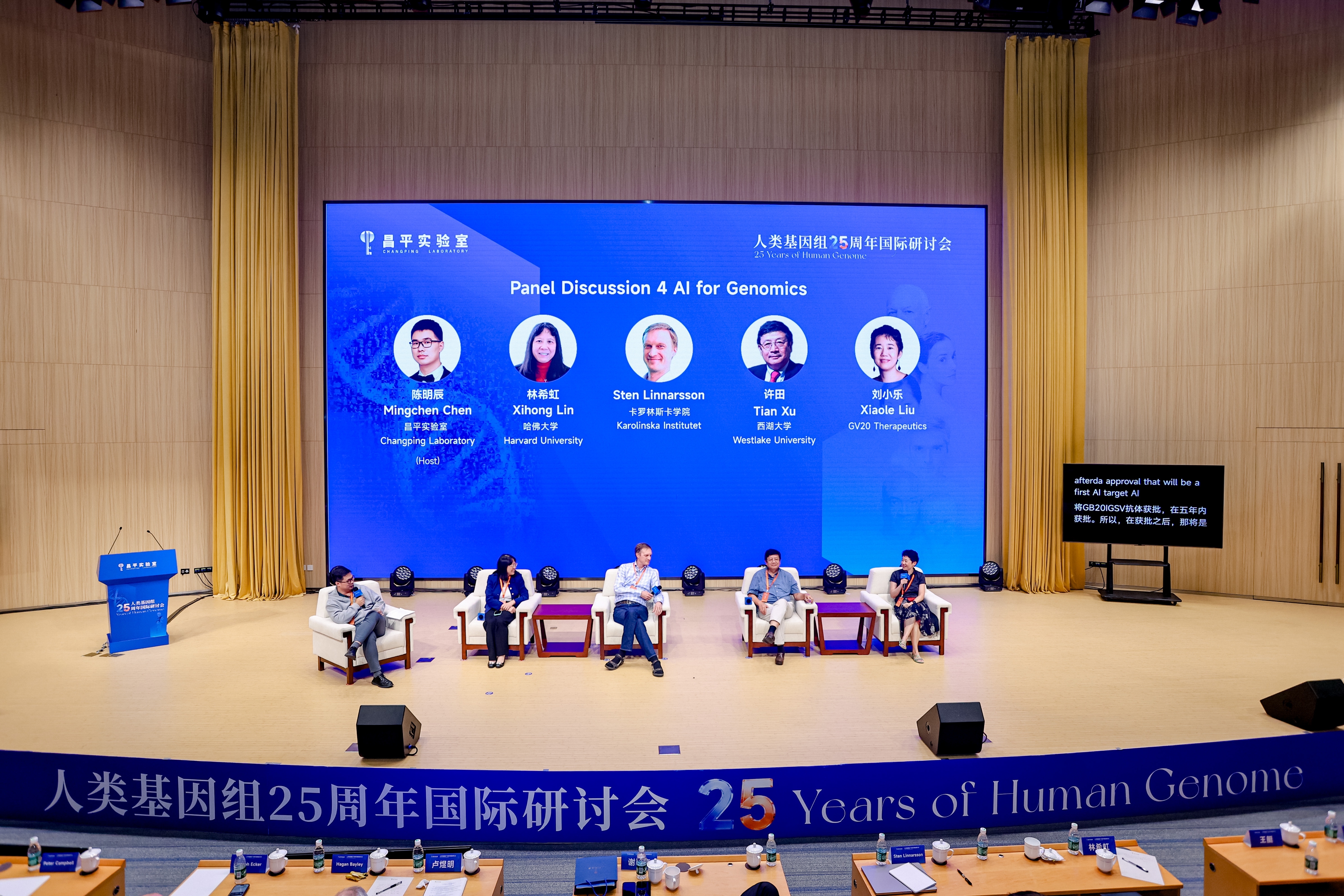
Panel Discussion 4
A panel discussion on “The Role of Artificial Intelligence in Genomics and Drug Discovery,” moderated by Mingchen Chen of Changping Laboratory, brought together Xihong Lin of Harvard University, Sten Linnarsson of Karolinska Institute, Tian Xu of Westlake University, and Xiaole Liu, Co-founder and CEO of GV20 Therapeutics. Rather than focusing solely on what AI is technically capable of doing, the discussion addressed a more consequential question: under what conditions can AI-generated predictions become reliable scientific discoveries and, ultimately, therapeutic interventions that benefit patients?
Where Does the Real Value of AI Lie?
Xihong Lin emphasized that biological systems are considerably more complex than their representations in computational models. Although concepts such as virtual cells are scientifically compelling, she cautioned that currently available biological data remain limited.
Sten Linnarsson similarly warned against predictions that AI will “cure all diseases within five to ten years.” Overstating the capabilities of AI, he argued, risks creating unrealistic expectations among both researchers and the wider public.
Tian Xu offered a more optimistic assessment. He suggested that the scientific community may be underestimating the creativity of artificial intelligence and its potential to transform how research itself is conducted. As data, computational resources, and other scientific capabilities become increasingly concentrated, AI could play a greater role not only in analyzing results, but also in formulating research questions, designing experiments, and identifying possible solutions.
Xiaole Liu approached the issue from the practical perspective of drug discovery and development. She cautioned that AI-generated molecular designs and virtual-cell models require rigorous evaluation. Modifying an existing molecule or designing around an existing patent does not necessarily amount to the discovery of a genuinely new drug. Moreover, some of AI’s most consequential applications may ultimately emerge in areas such as manufacturing, clinical trials, and commercialization rather than molecular generation alone. AI may help eliminate weak hypotheses, but it cannot bypass the progression from experimental validation to clinical testing.
From Prediction to Discovery: Where Is the Evidence?
This distinction between prediction and discovery became a central theme of the discussion. Lin emphasized the importance of uncertainty and causality: AI-generated predictions should be accompanied by appropriate measures of confidence, while statistical associations should not automatically be interpreted as validated therapeutic targets. Integrating statistical methods with AI and combining computational benchmarks with biological validation may reduce the number of unproductive experiments. The hypotheses that remain, however, must still be tested experimentally.
Linnarsson similarly stressed that translating scientific findings into patient benefit requires an understanding of causal relationships in humans. Complex biological systems, including the immune system, cannot be adequately understood through correlations alone. In many cases, effects must ultimately be evaluated in the context of the intact human organism, making randomized clinical trials indispensable.
How Far Is the Journey from Discovery to Drug?
Xiaole Liu described drug development as involving two distinct challenges: first, eliminating directions unlikely to succeed; and second, determining whether a candidate molecule merits progression into clinical development. AI and computational methods can integrate heterogeneous datasets and work alongside orthogonal experimental platforms to identify targets with low therapeutic potential. At this stage, the value of AI may lie primarily in conserving experimental resources and improving decision-making rather than in independently “discovering” a successful drug.
Tian Xu cited AlphaGo and AlphaFold as examples of how complex knowledge-intensive tasks that once required a small number of highly specialized experts could be transformed rapidly as computational resources and training data accumulate. The question, therefore, is not simply whether a particular model can accomplish a particular task. Rather, the broader question is what kinds of fundamental changes may occur when large-scale computational resources, data, and AI systems are deployed simultaneously across the research and development pipeline.
Five Years from Now: What Would Constitute Real Change?
To conclude the discussion, Mingchen Chen asked the panelists to identify concrete and testable benchmarks by which the impact of AI could be assessed over the next five years. Despite their differing perspectives, their responses converged on an important principle: progress cannot be measured solely in terms of faster predictions, more capable models, or higher levels of automation. Ultimately, AI must contribute to scientific and therapeutic advances that can withstand experimental and clinical validation and deliver demonstrable benefits to patients.
Xiaole Liu offered perhaps the most tangible benchmark. She noted that her team is working to advance an antibody therapeutic toward FDA approval within the next five years. From the perspective of drug discovery and development, she argued, the ultimate outcome is not an AI platform that continues to improve iteratively, but a therapeutic molecule that successfully progresses through clinical development and ultimately reaches patients.
Xihong Lin proposed a complementary scientific benchmark: identifying the causal variants and functional mechanisms underlying a limited number of diseases and translating those findings into actionable therapeutic targets. Such discoveries, she emphasized, would still require rigorous evaluation and validation through subsequent clinical studies.
Sten Linnarsson took a different view of the five-year horizon, arguing that there is no need to wait five years to determine whether AI will transform genomics and drug discovery. In his assessment, that transformation is already underway.
Tian Xu, meanwhile, looked toward the emergence of new forms of AI agents capable of becoming active participants in the scientific process. He expressed the hope that such systems could provide substantive assistance in scientific research and ultimately reshape the ways in which both research and product development are conducted.
Taken together, the discussion on virtual cells, research automation, drug discovery, and the capabilities and limitations of artificial intelligence pointed to a broader question confronting the next phase of genomics: how can increasingly powerful computational systems be translated into reliable scientific knowledge and, ultimately, meaningful improvements in human health?
The panelists offered no single answer. Their perspectives ranged from caution over the limitations of current data and the need for causal and experimental validation to optimism about AI’s potential to transform the scientific process itself. What emerged instead was a shared recognition that technological capability alone is not sufficient. The significance of AI in genomics will ultimately depend on whether computational advances can generate discoveries that withstand biological and clinical scrutiny and translate into tangible benefits for patients.
Discussions surrounding virtual cells, research automation, AI-driven drug discovery, and the boundaries of machine intelligence underscore a central question for the next era of genomics. The answers are unlikely to be simple, and perhaps only time will deliver a definitive verdict. Twenty-five years ago, few could have anticipated the profound impact genomic science would exert across the life sciences and biopharmaceutical industry. The next quarter-century promises to be equally transformative.
Watch the full recording of Panel Discussion 4 to explore expert perspectives on how artificial intelligence is reshaping the future of genomics, scientific inquiry, and therapeutic discovery.